Applied AI Symposium Covers Future Classes, Ethics and More
The second annual Applied AI in Engineering and Computer Science Symposium brought together academic and industry leaders on NC State University's campus.
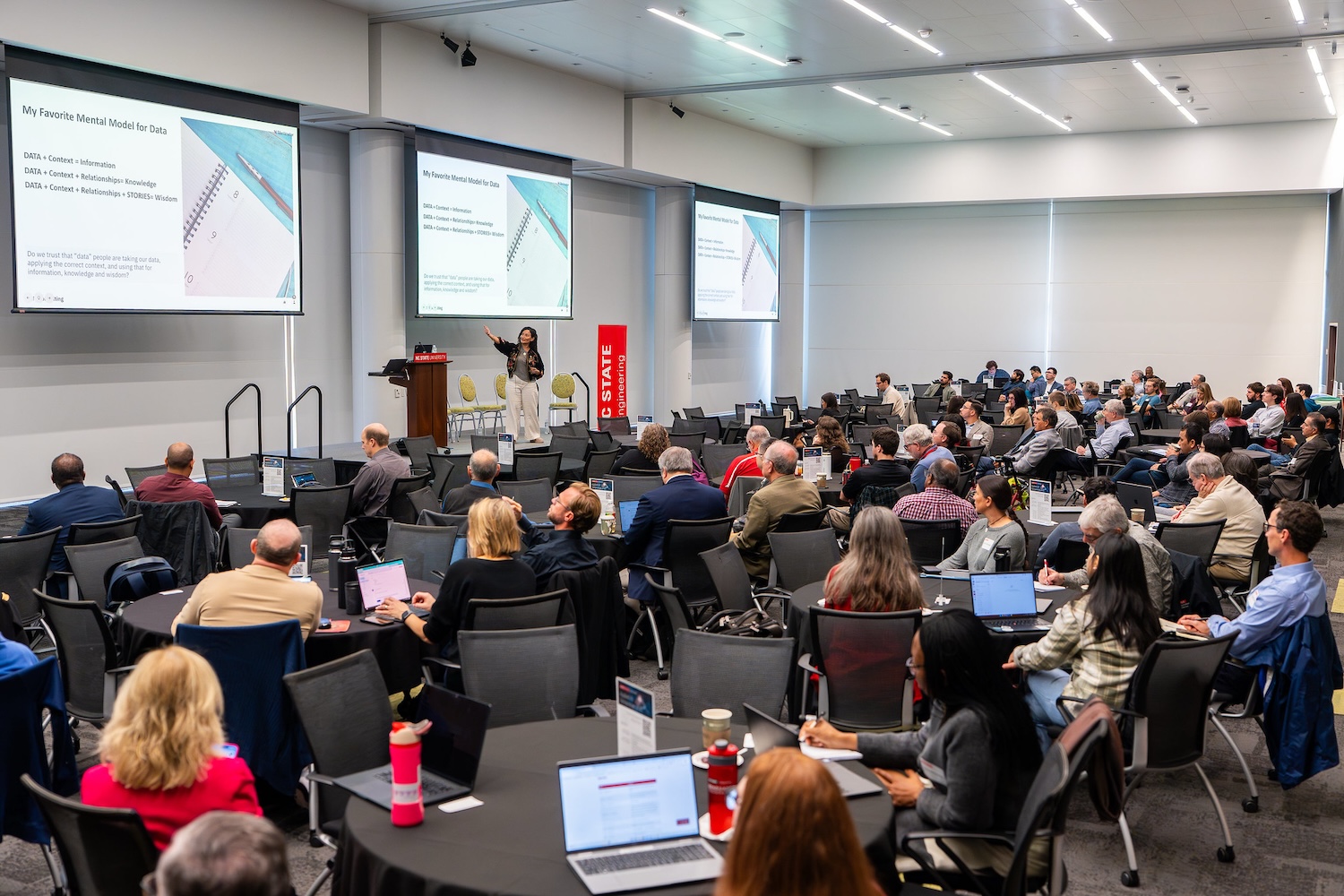
As NC State continues to lead the way in innovative and groundbreaking artificial intelligence (AI) research, curriculum development and teaching, College of Engineering hosted its second Applied AI in Engineering & Computer Science Symposium on Oct. 27.
The symposium is one of the first to bring together students, faculty and industry professionals to discuss the rise of AI in contemporary engineering. Academics from the College of Engineering and industry professionals addressed new courses at NC State, industry uses of AI and ethical concerns about AI use.
“The Applied AI in Engineering and Computer Science Symposium was a valuable opportunity for faculty, staff, students, industry representatives and other College of Engineering partners to come together and exchange ideas,” said Edgar Lobaton, professor in the Department of Electrical and Computer Engineering and the chair of the applied AI in engineering and computer science committee.
“It was inspiring to hear about the diverse ongoing efforts and future directions in applied AI across our community,” he continued. “I was truly impressed by the strong turnout and the enthusiasm everyone brought to learning from one another.”
Industry Navigates AI Ethics
The symposium’s keynote speaker, Phaedra Boinodiris, is the global lead for responsible AI for IBM Consulting. She works with College of Engineering students through IBM’s pathfinders mentors program.
Boinodiris is a member of the Global Council for Responsible AI representing the United States. She argued that AI use needs to be regulated thoroughly and that it should be used in moderation.
“AI is a mirror that reflects our biases back at us,” she said. “We have to be brave enough to say with transparency where we got the data.”

The industry panel discussion featured Vrushali Sawant, senior frontend engineer at SAS; Matthew Hetrich, principal research scientist and generative AI lead at ABB; Andrey Tapekha, distinguished engineer and CTO at Deutsche Bank; Ana Biazetti, senior principal engineer at Red Hat; and Katya Bilyk, associate vice president at Hazen and Sawyer.
Sawant spoke to the kind of skills that she wants to see in data science, which she said for engineers include building responsible models and also questioning them.
“Ethics is now a technical skill,” she said.
Bilyk mentioned that AI — her team is using Microsoft Copilot — has been especially helpful in software development.
”I’ve used it many times to describe the thing I’m looking for and see if they can find it,” she said. “It’s been very helpful.”
But she emphasized that Copilot can be wrong. The chatbot told Bilyk about a water treatment plant that her team had supposedly delivered when Bilyk knew they had not.
Alongside human fact checking, though, AI has identified water main breaks, which can cause flooding and costly repairs. Using AI has helped Bilyk’s team at Hazen and Sawyer, which is an engineering consulting firm that supplies services around drinking water and wastewater, to better serve their customers and keep them safe.
Other industry speakers included Luiz Cheim, senior principal engineer at Hitachi and senior member of the Institute of Electrical and Electronics Engineers, and Noah Roberts, education application engineer at MathWorks.
Teaching AI as a Core Skill
NC State professors Collin Lynch, associate professor in the Department of Computer Science, and Sarah Heckman, the director of undergraduate programs and teaching professor in the same department, emphasized the importance of teaching AI skills and that AI needs to be monitored by human eyes.
Lynch and Heckman spoke about current and future courses on AI at the College of Engineering. Currently, the college teaches a two-course sequence: Fundamentals of Applied AI for Engineering, which launched this fall, and Problem-Solving with Applied AI for Engineering, which starts this spring. Both are three-credit courses that cover ethical, professional and policy concerns.
While NC State has offered existing courses for upper level students, this is the first year AI-specific courses are available to the college’s 1,850 first-year students and 500 transfer students.
“The idea is to get students at the beginning to start working with the core concepts of [AI],” said Lynch.
Lynch’s main focus is to teach incoming students basic coding, using weekly labs to work on example problems in addition to weekly lectures focused on AI concepts and applications. Both new and existing courses will also cover the ethics and limits of AI.
As for the higher level courses, students will now be able to take tech electives and minor in applied AI with a focus on engineering.
Revolutionizing Student Learning at NC State
Jim Pfaendtner, Louis Martin-Vega Dean, College of Engineering, spoke about his AI priorities for the college, which include using AI broadly rather than using one popular tool. He emphasized how AI fits in with NC State’s Think and Do approach, with humans always working alongside AI for the best possible outcome.
He also mentioned two new programs to support faculty, the Applied AI Research Accelerator Award Program and the Applied AI Faculty Scholarship Fellowship Program. Applications for both are currently under review.
“One tool is not going to revolutionize the way students learn,” he said to the faculty in the room. “Your work will revolutionize the way students learn. I am certain about that fact.”

Outside Duke Energy Hall, nearly 100 postdoctoral and Ph.D. students showcased posters depicting how AI has already revolutionized their learning and research. Students are using AI to further research on autonomous vehicles, medical technologies including electric bandages and methods to find cancer subtypes and prevent liver failure, and more.
Attendees came away from the symposium feeling excited and hopeful about the future of AI education at NC State.
“Realizing that bringing AI into research and engineering education would be a collective, grassroots effort, in which I could play a part, was inspiring,” said Marie Muller, a professor in the Department of Mechanical and Aerospace Engineering. “It felt genuinely empowering.”
“We are doing things that are going to set the tone for the rest of the country,” said Pfaendtner. “It’s never been more important to find ways for technology to support learning.”
This post was originally published in College of Engineering News.
- Categories:


